
by Allegra Giovine
Originally published on the Stone House Museum’s “From the Archives” blog on July 21, 2025: http://stonehousemuseum.org/beginnings-of-the-revolutionary-war/
This year marks the 250th anniversary of the start of the American Revolutionary War. By July, 1775 (that is, exactly 250 years before this blog post), Belchertown residents were very much caught up in war activities. This post examines some of the archival records in the Stone House Museum that capture events in the year leading up to that July.
Anger with British rule in the colonies grew in the decade or so prior to war, especially following the Stamp Act of 1765. But revolution emerged as a real possibility only in 1774, after the passage of the so-called Intolerable Acts that took rights away from colonists in Massachusetts, among other penalties following the Boston Tea Party.
In response to these harsh measures from British Parliament, all thirteen colonies organized to send representatives to the first Continental Congress, to be held in Philadelphia in September 1774. Members of the Massachusetts House of Representatives arranged to meet in secret on June 17, 1774 to appoint their delegation, and—in order to pay for the delegation’s travel to Philadelphia, knowing any usual legislative action to raise funds would be vetoed by the newly installed Governor Gage—the House recommended:
“to the several towns and districts within this Province, that each town and district raise, collect and pay, to the Honourable Thomas Cushing, Esquire, of Boston, the sum of five hundred pounds, by the fifteenth day of August next, agreeable to a list herewith exhibited, being each town and district’s proportion of said sum […]”[1]
Belchertown’s proportion? According to a receipt signed by Thomas Cushing on August 4th, 1774, Joseph Bardwell paid “the sum of one pound one shilling and four pence”—that amount being Belchertown’s “Proportion of five hundred pounds voted to defray the charge of the Congress.”

While their provincial delegates met in Philadelphia, Belchertown residents expressed their outrage at recent injustices in a public meeting held in town that September. Early Belchertown historian Mark Doolittle quotes the compact signed at that meeting:
“We declare that we will take no unreasonable liberties or advantage from the suspension of the course of law; but we engage to conduct ourselves agreeable to the laws of God, of reason, and of humanity; and we hereby engage to use all prudent, justifiable, and necessary measures, to secure and defend each other’s persons and families, their lives, rights, and properties against all who shall attempt to hurt, injure, or invade them; and to secure and defend to ourselves, and our posterity, our just and constitutional rights and privileges.”[2]
At the end of that month, Belchertown sent three men to a meeting of towns from across Hampshire County. Caleb Clark, Joseph Smith, and then Town Clerk, Nathaniel Dwight attended the Hampshire County Convention held in Northampton September 23–24. Dwight reported back to Belchertown what was discussed at Northampton:
“They spent the day in considering the distressed state of the government, as the port of Boston is shut up by the King and by Parliament; and eight or ten regiments stationed there upon the Common and upon the Neck, and digging trenches and fortifying them against the country; and as a number of men-of-war are round about Boston, in order to oblige the province to acknowledge the right of Great Britain to tax North America at their pleasure.”[3]
The first detailed historical accounts of Belchertown’s involvement in the Revolutionary War were assembled by Rev. Payson Williston Lyman, who was pastor of Belchertown’s Congregational Church when he was invited to give the historical address at the Centennial Fourth at Easthampton’s Mansion House on July 4th, 1876. In preparing his remarks, Lyman assembled an addendum on Belchertown’s involvement in the Revolutionary War. The address is digitized online here and the “Belchertown War Record” begins on page 87.

Lyman chronicles how Belchertown responded to county and provincial resolutions as tensions escalated in late 1774 and early 1775. On October 4th, Samuel Howe was chosen to represent Belchertown at Massachusetts’ first Provincial Congress. Later that month, the Provincial Congress issued a clear resolve to all inhabitants of Massachusetts: get ready for war.
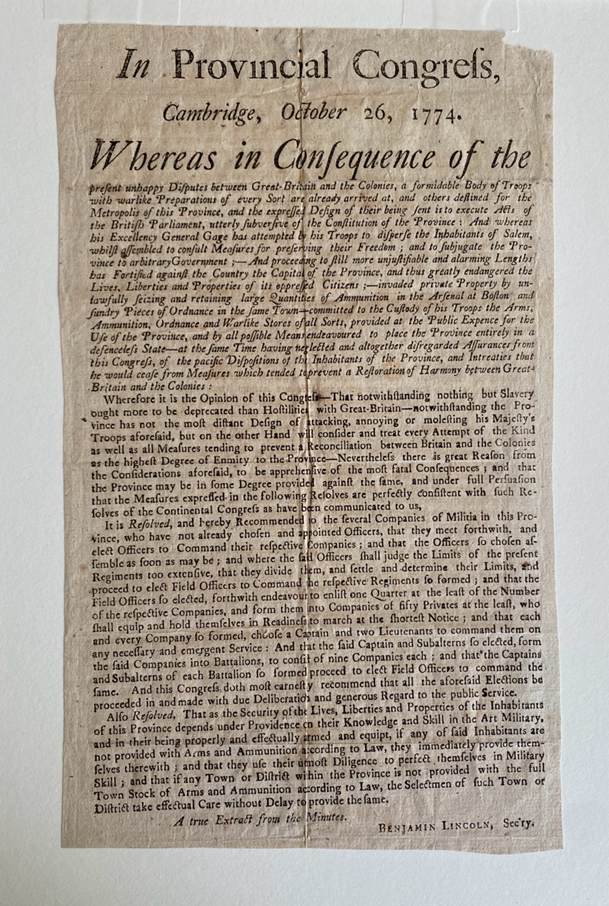
Companies of Local Militia, Cambridge, October 26, 1774. Stone House Museum Archives, Box 91 (Acts and Resolves). (Also digitized by the State Library of Massachusetts here.)
Belchertown responded by organizing a military company under the command of Captain Caleb Clark at a meeting on November 7th. In these and further deliberations that winter, town officials sorted out how to ensure Belchertown’s supply of ammunition. In February, Belchertown appointed its first Committee of Safety, one of many such local bodies across the colonies charged with broad wartime decision making. Then in April 1775, immediately after the “shots heard round the world” in Lexington and Concord, Belchertown started sending men east: dozens of names of Belchertown men appear in the lists of several companies that marched that April and May. Alongside their service we can find record of our town’s actions to support its soldiers, such as this early receipt from Jonathan Bardwell to the Selectmen on May 8th. Bardwell, captain of a company that marched on April 20th to Cambridge, acknowledged receipt of nine pounds used to purchase twenty blankets for twenty Belchertown men.

Who served when and where is the subject of future blog posts that will examine muster-rolls, service records, and war journals of Belchertown men.
Thanks to Michael Carolan and Cliff McCarthy for their feedback on drafts of this piece.
[1] Resolutions of the House of Representatives of Massachusetts on June 17, 1774. The full text of the resolutions, alongside the Governor’s attempt to dissolve the secret gathering, can be found in Peter Force’s American Archives; see columns 421-422 of Vol. 1 of the Fourth Series: A Documentary History of the English Colonies in North America, from the King’s Message to Parliament, of March 7th, 1774, to the Declaration of Independence by the United States (Washington, 1837).
[2] Quoted on page 46 of Mark Doolittle, Historical Sketch of the Congregational Church in Belchertown, Mass. (Northampton, Mass.: Hopkins, Bridgman & Co., 1852).
[3] Quoted on page 88 of Payson W. Lyman, Historical Address Delivered at the Centennial Celebration, in Easthampton, Mass., July 4, 1876 (Springfield, Mass: Clark W. Bryan & Company, 1877).

 Pioneer Valley History Network